Understanding Service Dog Vests, Identification and Provincial Rules
A vest can be useful. It can help identify a working dog, reduce unwanted approaches and make public access more straightforward.
But a vest is equipment. It does not, by itself, turn a dog into a service dog.
There is no single Canadian vest that establishes service dog status everywhere in the country. The answer depends on where you are, which legal framework applies and whether you are relying on a provincial certification or qualification system.
The most important distinction is this:
A dog’s training and behaviour matter more than the appearance of its equipment.
At the same time, provincial laws may attach specific identification requirements to teams certified under those systems. It is important to understand both points together.
The short answer
Service dogs in Canada do not all follow one national vest rule.
Depending on the province and situation:
- A vest may be optional practical equipment.
- A collar or harness with specific wording may be required under a provincial certification system.
- A government-issued identification card may be relevant.
- A federally regulated transportation provider may request training documentation.
- A vest purchased online does not prove training, certification or legal access rights.
Certification in British Columbia, Alberta and Nova Scotia is voluntary. Handlers are not required to register their dogs in order to train or work with them. However, voluntary certification may provide a particular form of statutory recognition or access protection, and certified teams must follow the requirements connected to that system.
The province certifies teams; trainers prepare them.
Four things people often conflate
1. A vest or harness as functional equipment
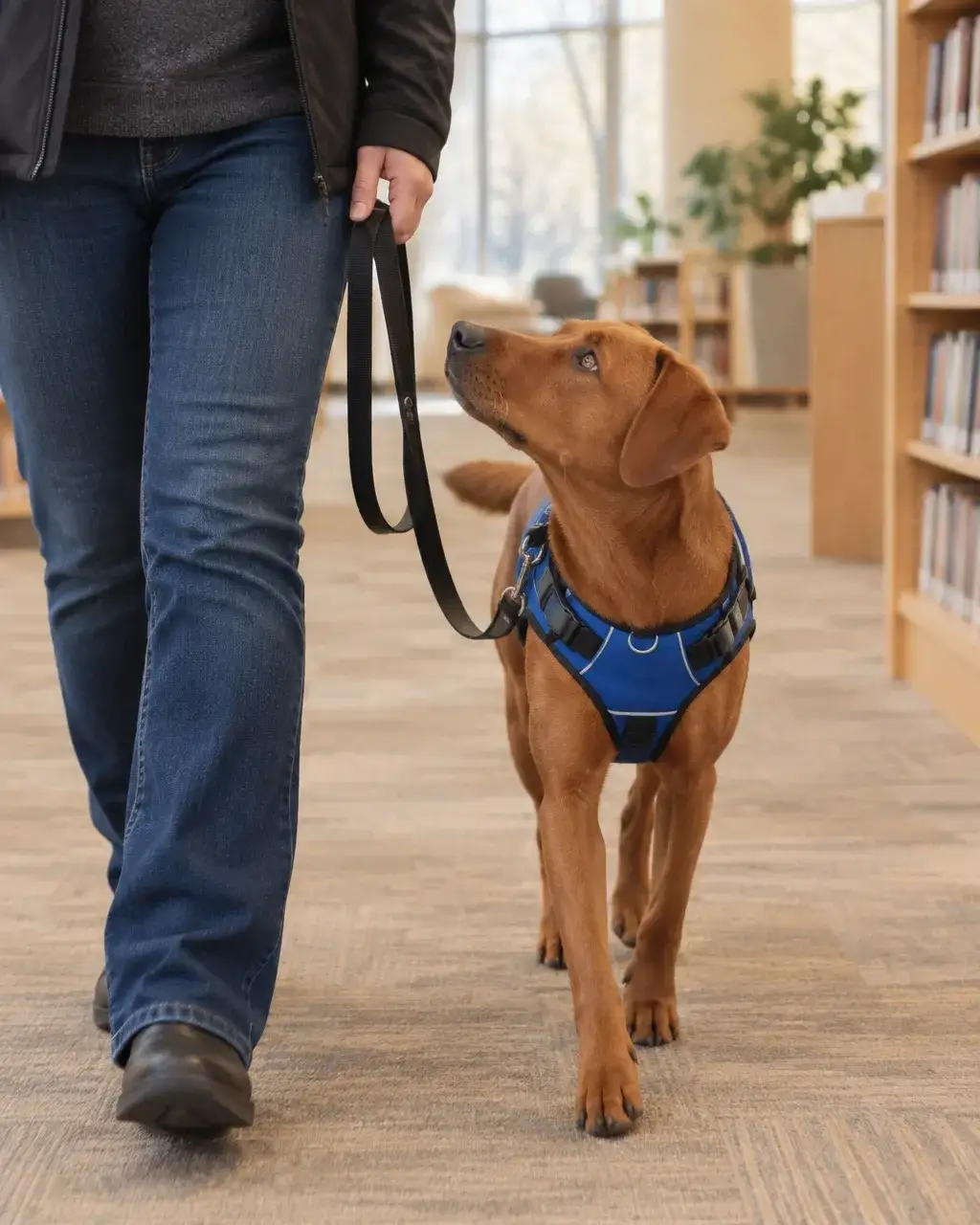
A vest, harness or other working equipment may serve several practical purposes.
Handlers may choose equipment for:
- Fit and comfort.
- Visibility in busy environments.
- Task support.
- Safe leash attachment.
- Clear communication with members of the public.
- Compatibility with mobility equipment.
- Weather and temperature needs.
Some service dogs work in a vest. Others use a harness, collar or task-specific equipment. Some may not wear the same equipment in every setting.
Equipment should support the dog’s work. It should not restrict movement, create discomfort or interfere with task performance. A working dog still needs to walk, lie down, turn, settle and complete trained tasks safely.
A vest is therefore best understood as one part of a working partnership. It is not the source of the dog’s training.

2. Private identification purchased online
Online businesses sell service dog vests, patches, cards, certificates and registration packages. These products may look official, but purchasing them does not create service dog status.
A commercial registry cannot:
- Certify a team under provincial law.
- Replace an official provincial identification card.
- Confirm that a dog performs disability-related tasks.
- Guarantee public access.
- Establish that the handler meets a legal requirement.
Words printed on equipment do not change the dog’s training. A card purchased online does not become government-issued identification simply because it includes a serial number or a photograph.
We explain this in more detail in our guide to fake service dog registries and why they do not certify your dog.
3. Government-issued identification
Some provinces have certification or qualification systems that issue identification to recognized teams.
The requirements are not identical across Canada.
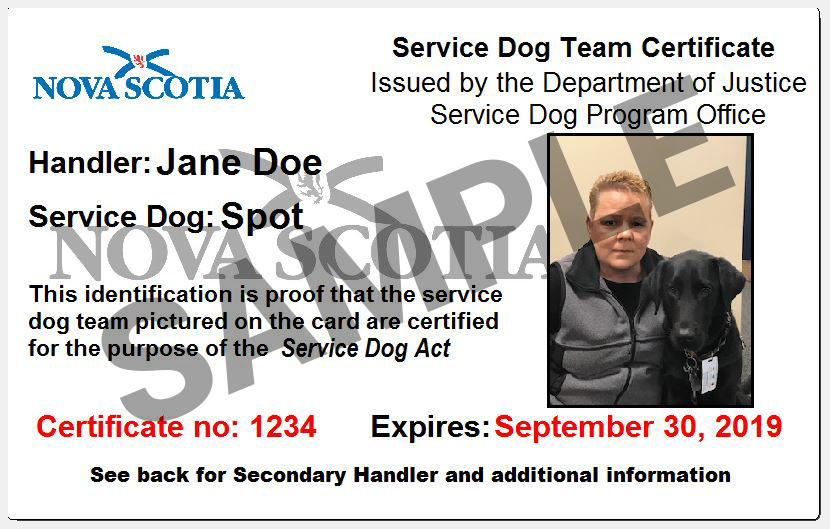
In Nova Scotia, the Service Dog Act includes an identification requirement for teams certified under the Act. The dog must wear an identification collar or harness in public, and the words “service dog” or another prescribed expression must be clearly displayed. The handler must also produce the provincial identification card when requested by an authorized person in the circumstances described by the Act.
This is a provincial requirement attached to certification. It is not a universal Canadian vest rule.
British Columbia has a voluntary certification system under its Guide Dog and Service Dog Act. Certified teams receive provincial identification, while teams from accredited schools may rely on valid school-issued identification recognized under the provincial framework. The province’s public access rules focus on certification, control and safety rather than requiring one particular vest style.
Alberta also has a provincial qualification system and government-issued Service Dog Identification Cards. The card verifies that an individual and their service dog have protected public access rights under the Alberta framework. A generic vest purchased online is not a substitute for that provincial identification.
Requirements can change. If you are relying on provincial certification, review the current requirements for the province where you are travelling, working or requesting access.
4. The dog’s training and behaviour
A service dog is not defined by colour, breed, vest style or patch.
The substantive foundation is the dog’s training to perform tasks related to a person’s disability, together with reliable behaviour and safe public conduct.
A service dog should be able to:
- Remain under the handler’s control.
- Work without disrupting other people.
- Settle appropriately in public places.
- Respond to trained cues.
- Perform disability-related tasks reliably.
- Navigate ordinary environmental challenges safely.
- Maintain appropriate behaviour around people and animals.
Certification may provide legal recognition within a provincial system. It does not replace training. Conversely, training organizations and private trainers do not issue provincial certification unless authorized to do so by the applicable system.
Our service dog programs are designed to help handlers develop practical skills through structured, individualized training.
No Vest Doesn’t Automatically Mean Fake, and a Vest Doesn’t Automatically Mean Legitimate
This is the heart of the issue.
A trained service dog does not become untrained when its vest comes off. The dog’s skills, tasks and working behaviour do not disappear because equipment is removed for rest, grooming, transportation or another welfare-related reason.
At the same time, anyone can purchase a vest online. The words “SERVICE DOG” printed on equipment establish neither appropriate training nor that the handler meets the legal requirements of a particular province.
The public should not judge a dog’s status from equipment alone. Businesses should also avoid treating a vest as conclusive proof.
A better approach is to understand:
- What the dog is trained to do.
- Whether the dog is under control.
- Whether the dog is behaving safely.
- Which provincial or federal rules apply.
- What form of documentation, if any, may lawfully be requested.
For more information about questions businesses may ask, read Can a business ask for proof of a service dog in Canada?.
Why handlers may choose identifying equipment
Even where a particular vest is not legally required, many handlers choose visible working equipment.
That decision is often about avoiding confrontation, not appearance.
Clear identification may:
- Discourage people from approaching or touching the dog.
- Reduce repeated questions.
- Help staff recognize that the dog is working.
- Make it easier to move through busy spaces.
- Support a calmer, more predictable public access experience.
- Reduce the need for the handler to explain private medical information.
A handler should not have to educate every passer-by before entering a public place. A visible harness or vest can communicate a simple boundary: the dog is working and should not be distracted.
However, equipment cannot prevent every misunderstanding. The handler may still be asked about the dog, and the applicable rules may still require documentation or official identification.
Practical equipment considerations
The safest equipment is equipment that fits the individual dog and supports the work.
Before using a vest or harness regularly, consider:
Comfort and fit
Check that the equipment does not rub, pinch or restrict breathing. You should be able to assess the fit regularly, especially if the dog is growing or changing weight.
Heat and weather
Heavy or poorly ventilated equipment may increase discomfort in warm weather. A dog’s welfare should come before visual identification.
Freedom of movement
The dog should be able to walk, lie down, turn and perform tasks without interference. Mobility-assistance equipment requires particular care because inappropriate pressure can affect the dog’s body and movement.
Task performance
If a vest, handle or attachment changes how the dog moves or responds, introduce it gradually and monitor the dog’s behaviour. Equipment should be part of training, not an afterthought.
Public clarity
Use clear, accurate markings if you choose identifying equipment. Avoid implying a certification, organization or government endorsement that does not exist.
Federal rules and provincial rules are different
Canada’s legal framework has more than one layer.
Most everyday public access questions, such as restaurants, shops and many workplaces, are governed primarily by provincial or territorial law and human-rights legislation. Provincial governments may create certification systems, while provincial human-rights laws may protect people with disabilities who rely on service animals outside those systems.
The Canadian Human Rights Act applies to federally regulated organizations and services. The Accessible Canada Act supports accessibility requirements for organizations within federal jurisdiction. Neither creates one national service dog vest or registration system.
Federally regulated transportation has its own rules. Under the Accessible Transportation for Persons with Disabilities Regulations, carriers may require a declaration at reservation and an identification card or other document from a person or organization specializing in service dog training before departure. Carriers may also require the dog to be controlled with a leash, tether or harness.
Those transportation requirements concern training and control. They do not create a universal federal vest requirement.
If you are travelling, contact the carrier early and confirm its current documentation process. Do not assume that a commercial vest or online certificate will meet the carrier’s requirements.
What should handlers remember?
If you are training or working with a service dog:
- Choose equipment for comfort, safety and function.
- Check the requirements in each province where you will rely on access rights.
- Do not treat online cards or registries as official recognition.
- Carry relevant documentation when a provincial or transportation framework requires it.
- Monitor your dog’s welfare in every environment.
- Remember that public access depends on more than appearance.
If you are beginning the process, our guide to training your own service dog in Canada explains why structured preparation and realistic progression matter.
A vest can communicate. A card can identify. Neither one replaces the training and behaviour that make a reliable service dog partnership possible.
Support for your next step
We provide ethical, evidence-informed training for service dogs and companion pets in Nova Scotia and British Columbia. Plans are individualized, progress is monitored and safety and welfare remain priorities.
Melanie Burneau
Owner & Head Trainer
Pawsitively Service Dogs Inc.
- Nova Scotia: melanie@pawsitivelyservicedogs.ca
- British Columbia: jenn@pawsitivelyservicedogs.ca
- General inquiries: info@pawsitivelyservicedogs.ca
You can review our service dog programs or contact us to discuss your goals, your dog and the requirements that apply to your situation.