Why Service Dog Training Takes Time
If you are asking, “how long does it take to train a service dog?”, the most accurate answer is that there is no single completion date for every dog and handler.
A service dog training timeline depends on the dog’s age, maturity, previous training, temperament, health, task requirements, handler participation and demonstrated progress. Some teams may be ready for an applicable assessment after a structured program. Others need additional time, more practice or a different training plan.
At Pawsitively Service Dogs Inc., we provide a clear framework without promising an outcome that cannot responsibly be guaranteed. Training is planned, monitored and adjusted around the individual team.
No trainer or program can promise a specific completion date. That is not a limitation of good training. It is an honest recognition that each dog develops at a different pace and that service work must remain safe, reliable and appropriate.
The short answer
Service dog training usually involves several stages rather than one continuous block of obedience training.
The overall process may include:
- Candidate assessment and program planning
- Foundation skills and handler engagement
- Emotional regulation and environmental confidence
- Public access training
- Generalisation across locations and distractions
- Individualised disability-mitigating task training
- Reliability practice and assessment preparation
- Ongoing maintenance after training milestones are reached
The time required depends on how consistently the dog demonstrates the skills needed for the next stage. A dog may understand a behaviour at home but still need substantial practice before performing it calmly in a busy store, restaurant, workplace or transit environment.
What determines the timeline?
Age and developmental maturity
A young dog is still developing physically, emotionally and socially. Age does not automatically determine suitability, but maturity affects the dog’s ability to cope with duration, distractions, environmental changes and the demands of public work.
This is one reason we assess potential service dog candidates under four years old. Training takes time, and a dog needs a sufficient remaining working life after training is completed. Assessing earlier gives us more opportunity to evaluate development, build skills carefully and make responsible decisions about long-term welfare.
Age is only one consideration. We also review:
- Temperament and recovery from stress
- Comfort in unfamiliar environments
- Ability to remain neutral around people and dogs
- Responsiveness to the handler
- Health and physical suitability
- Ability to learn and retain skills
- Behavioural stability over time
A potential service dog assessment costs $150 plus applicable tax. An assessment is not a certification and does not guarantee acceptance into a program or eventual service dog status.
For more information about suitability, get in touch with us.
Previous training and current skills
A dog with reliable foundations may be ready to progress sooner than a dog beginning with limited training experience. However, existing obedience does not necessarily mean a dog is ready for service work.
We need to assess whether skills remain reliable when the dog is:
- Walking through unfamiliar spaces
- Settling for longer periods
- Working around food
- Passing people and dogs
- Recovering from unexpected sounds
- Moving through narrow or busy areas
- Responding while the handler is under stress
The goal is not simply to collect commands. The goal is to develop a stable working partnership that functions in the environments relevant to the handler’s daily life.
Public access reliability
Service dog public access training requires skills to generalise beyond the training room.
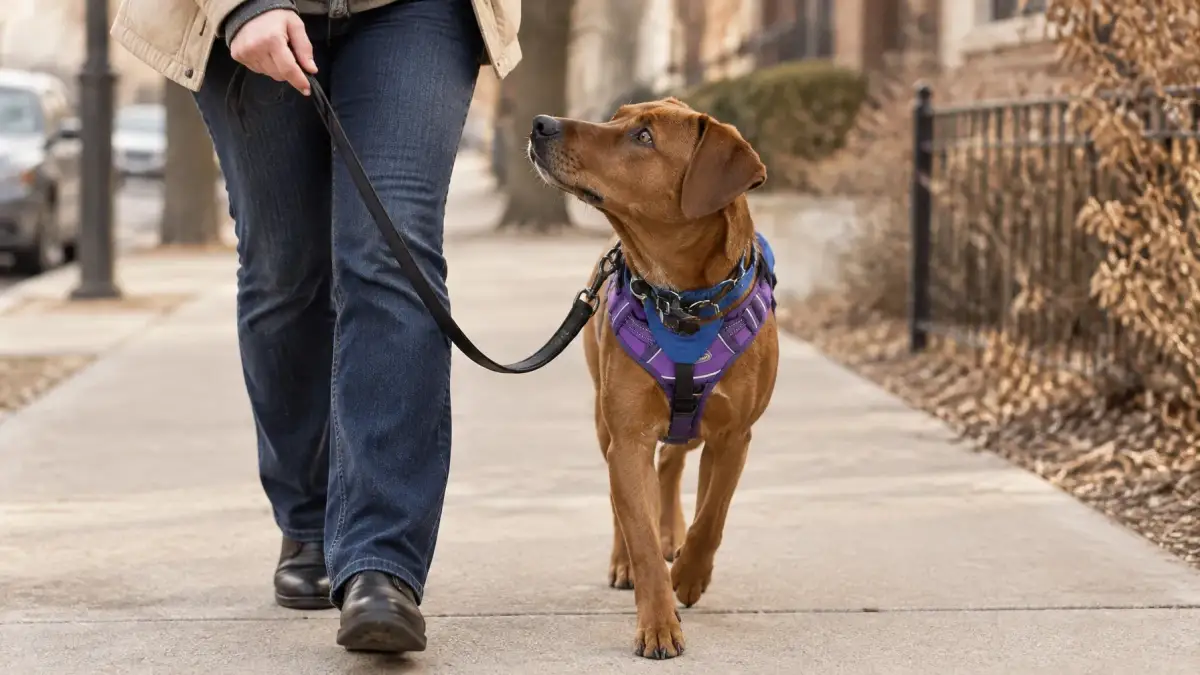
A dog may perform a loose-leash walk in a quiet neighbourhood but need further practice before navigating:
- Store entrances and automatic doors
- Elevators and stairs
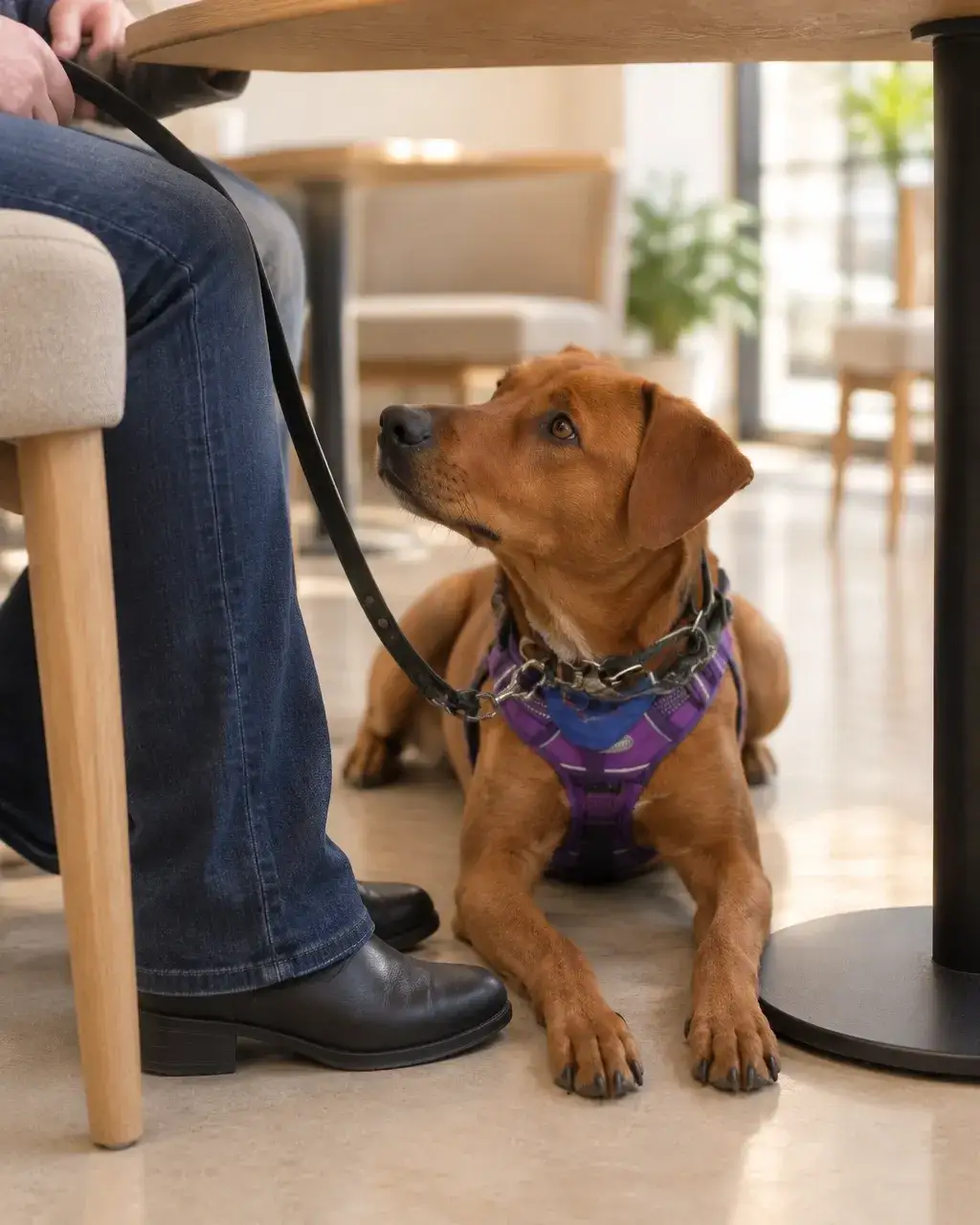
- Restaurant seating
- Public transit
- Crowded aisles
- Shopping carts
- Dropped food
- Unfamiliar surfaces and sounds
Progression should be conditional. We increase difficulty when the dog is emotionally stable and demonstrating reliable performance at the current level.
Our Service Dog Programs include public access training, handler coaching, generalisation and preparation for applicable testing. You can also review the Owner-Trainer Curriculum for a more detailed view of the skills introduced throughout the program.
Task complexity
Service dog task training is individualised. There is no universal task list that every service dog should perform.
Tasks may involve retrieving, interruption or response behaviours, alerts, deep pressure, mobility-related assistance where appropriate, or other actions that directly mitigate the effects of a handler’s disability.
The complexity of a task affects the timeline. We need to consider:
- Whether the task is physically and emotionally appropriate for the dog
- How clearly the task can be defined
- How consistently the dog performs it
- Whether the task remains reliable in relevant environments
- Whether the task can be performed safely
- How the handler will recognise and reinforce the behaviour
A task is not complete simply because a dog performs it once during a lesson. It must be practised, strengthened and generalised. Reliability is developed through clear criteria, appropriate reinforcement and careful repetition.
How our 12-month program is structured
Our One-Year Owner-Trainer Program provides 104 hours of individualised training and guidance over 12 months. The program supports both ends of the leash. You learn how to handle, practise, observe and maintain the skills your dog is developing.
The curriculum includes:
- Engagement and relationship building
- Foundation obedience
- Public access foundations
- Emotional regulation
- Advanced walking and heeling
- Food and restaurant neutrality
- Dog and human neutrality
- Advanced public access
- Individualised disability-mitigating task training
- Task reliability and generalisation
- Mock public access testing
- Certification preparation and readiness review
The 12-month structure provides a deliberate sequence. Each stage builds on the previous one. It also creates regular opportunities to review progress, identify areas requiring more practice and adjust the plan when necessary.
However, 12 months in the program does not mean that every dog automatically becomes a finished service dog at exactly the one-year mark.
The outcome and timeline may be affected by:
- The dog’s age and maturity
- Previous training experience
- Temperament and environmental stability
- The complexity of the required tasks
- The handler’s practice between sessions
- The team’s ability to generalise skills
- Health, welfare and safety considerations
- Progress shown during ongoing evaluations
The program provides structure, education and guidance. It does not provide an automatic graduation date.
Why 104 hours does not represent the whole process
The 104 hours are scheduled, individualised training and guidance with our team. They are not the only hours involved in service dog development.
Your dog also needs regular practice between appointments. Short, successful training sessions help maintain learning and provide information about what is working in daily life.
Your role may include:
- Practising current skills at home
- Recording public outings
- Tracking task reliability
- Noting stress signals and recovery
- Maintaining appropriate reinforcement
- Following welfare and rest recommendations
- Reviewing trainer feedback
- Reporting changes promptly
The quality and consistency of this practice can affect how efficiently the team progresses. We monitor development through session notes, evaluations, outing logs, task trackers and readiness checklists.
Training may also slow down when a dog needs additional time to feel safe or when a skill is not yet stable. That is part of responsible progression.
Service dog training is not the same as certification
Training and certification are separate matters. Pawsitively prepares teams for applicable public access or provincial testing, but the province certifies teams; trainers prepare them.
In British Columbia, Alberta and Nova Scotia, provincial service dog certification is voluntary. Handlers are not required to register their dogs in order to train or work with them. Provincial rules about access, documentation and the specific protections attached to certification can differ, so you should review the current requirements in your province.
A vest, online registry, identification card or private certificate does not independently establish service dog status. We do not certify teams, and we do not guarantee that a dog will qualify as a service dog.
If you are considering owner-training, our article Can You Train Your Own Service Dog in Canada? explains more about the handler’s role and the responsibilities involved.
A realistic way to think about the timeline
Instead of asking for one fixed number, consider whether the team is ready for the next stage.
Skills
Can the dog perform the current behaviour reliably in a suitable environment?
Practice
Has the team practised the behaviour frequently enough to understand its strengths and limitations?
Progression
Can the dog manage a slightly more challenging setting without losing emotional stability?
Generalisation
Does the skill hold up across locations, surfaces, distractions and routines?
Readiness
Can the dog work safely and appropriately for the handler’s actual needs?
This approach gives you a more useful answer than a promise of a particular completion date. It also protects the dog’s welfare and helps the handler make informed decisions.
A structured path with honest support
Training a service dog is a significant commitment. You deserve a plan that is clear about the work involved, responsive to your circumstances and honest about uncertainty.
Our role is to provide evidence-informed guidance, individualised coaching and ongoing feedback. Your role is to participate, practise and communicate openly about your dog’s progress.
For a deeper explanation of the values behind a gradual, welfare-focused approach, read Why Service Dog Training Takes Time, and Why That’s a Good Thing. This article focuses specifically on the practical service dog training timeline, program structure and factors that influence how long service dog training takes.
When you are ready, you can contact us to discuss your goals and the next appropriate step.
Melanie Burneau
Owner & Head Trainer
Pawsitively Service Dogs Inc.
Nova Scotia: melanie@pawsitivelyservicedogs.ca
British Columbia: jenn@pawsitivelyservicedogs.ca
General inquiries: info@pawsitivelyservicedogs.ca