By Melanie Burneau, Owner & Head Trainer, Pawsitively Service Dogs Inc.
Training and certification are different processes
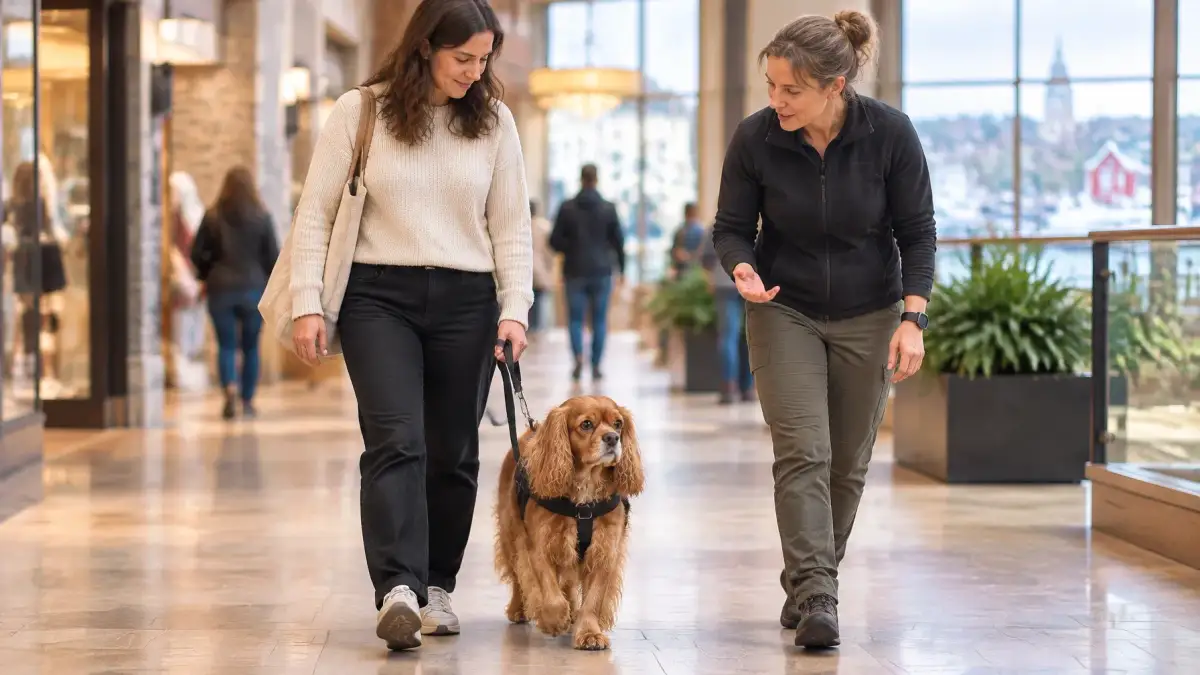
A trainer can help you build safe, reliable public-access skills and disability-mitigation tasks. A trainer can assess suitability, develop an individual training plan, monitor progress, and prepare you for an assessment.
A private trainer cannot certify your service dog team.
In Nova Scotia, the provincial government decides whether a person and dog qualify for certification under the Service Dog Act. The Act, SNS 2016, c. 4, came into force in 2018. It is administered by a Registrar within the Nova Scotia Department of Justice through the provincial Service Dog Program.
Certification is voluntary. You are not required to register your dog to train or work with them. However, the Act’s specific public-access and tenancy protections attach to certified teams.
Certification is for the team. It recognises the relationship between a person with a disability and a dog trained to perform disability-related tasks.
What Nova Scotia certification protects
A certified service dog team has public-access protection under the Act. The team may enter and use places, accommodations, buildings, and conveyances where the public is invited or allowed.
Examples include:
- Restaurants, cafés, and other food-service locations.
- Hotels and rental accommodations.
- Shops, malls, banks, and other retail settings.
- Public transit, taxis, and other conveyances.
- Hospitals, medical offices, schools, and universities.
- Parks and entertainment venues.
A landlord cannot deny or condition residential tenancy because a tenant has a certified service dog, subject to the limited exceptions set out in the legislation.
Certification also provides a provincial identification card. The card identifies the human member and dog member of the team. A handler is expected to produce it if asked by an authorised person, such as a landlord or the person responsible for a public place.
Certification does not mean that people without certification have no rights. A person with a disability who relies on a medically required, highly trained service dog may still file a complaint with the Nova Scotia Human Rights Commission if they experience discrimination.
The Service Dog Act does not cover pets, emotional support animals, or therapy dogs. Guide dog teams are protected under the separate Blind Persons’ Rights Act.
The Act also prohibits falsely representing a dog as a service dog team, retired service dog team, or dog-in-training team. The legislation provides for fines of $500 to $3,000 for specified offences. Laws and penalties can change, so review the current Service Dog Act or contact the Service Dog Program for current wording.
The two routes to certification
Nova Scotia provides two main routes.
Route 1: Dog trained by an accredited school
This route applies when a dog has been trained by an accredited school as defined in the regulations. This may include a school accredited by Assistance Dogs International (ADI) or the International Guide Dog Federation (IGDF).
The applicant submits:
- The appropriate provincial application.
- Written confirmation from the accredited school that the dog completed its service dog training.
- A passport-style photograph of the handler and dog together.
A team trained through an accredited school does not need to complete the additional provincial public safety assessment.
This route is not the same as buying documentation online. The school must meet the applicable accreditation and regulatory requirements.
Route 2: Privately trained dog
Most owner-trainers use the privately trained route.
“Privately trained” means that the dog was not trained by an accredited school. It does not mean that a handler can purchase a certificate, register a dog on a website, or self-declare certification.
The handler applies through the Nova Scotia Service Dog Program. The handler and dog must then pass a public safety assessment administered by St. John Ambulance on the province’s behalf.
Documents for the privately trained route
Government forms can change. Confirm the current requirements and form versions with the Service Dog Program before submitting an application.
The privately trained application package includes:
- A completed privately trained service dog application form.
- A medical form confirming the need for a service dog, completed by a physician or nurse practitioner.
- A veterinary form confirming that the dog is spayed or neutered. The veterinary form also addresses health and vaccination information.
- A recent passport-size photograph of the handler and dog together.
- Any additional information requested by the Registrar or current application instructions.
There is no application fee for provincial certification itself. A fee applies to the public safety assessment.
What the public safety assessment tests
The assessment is a real-world safety test. It is not simply an obedience demonstration.
The official Nova Scotia assessment contains 40 exercises in a public setting, such as a shopping mall. The team must pass all tasks before St. John Ambulance forwards the results to the Registrar.
The assessment considers whether:
- The dog is calm, stable, and reliable in everyday situations.
- The handler maintains control at all times.
- The dog is safe and unobtrusive in public.
- The dog demonstrates the standard of training expected of a service dog.
- The handler understands the dog’s care and welfare needs.
Examples of assessed skills include:
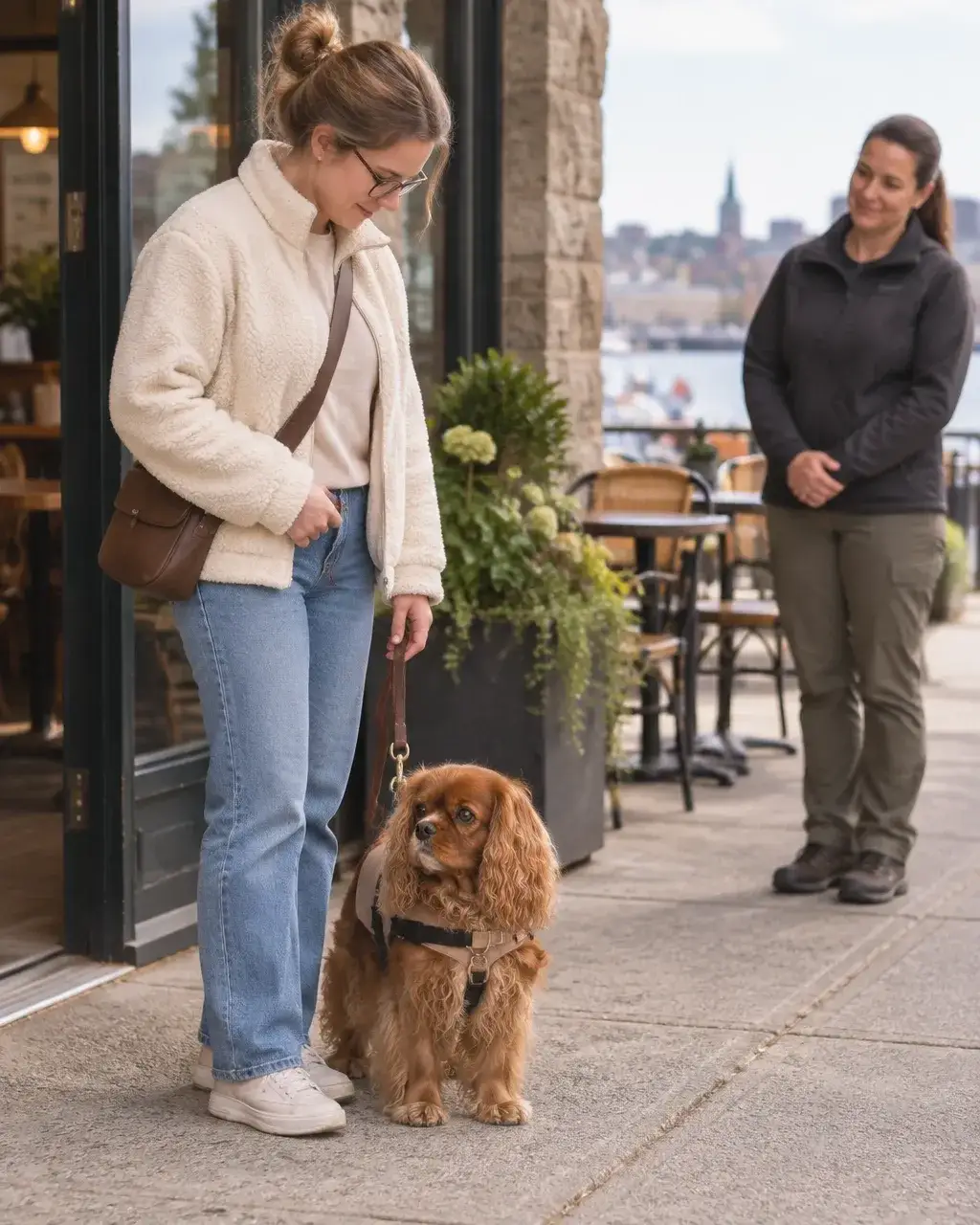
- Calmly entering and exiting a vehicle or building.
- Heeling through crowds and narrow spaces.
- Ignoring food on the floor or near a restaurant table.
- Remaining composed around shopping carts, traffic, and sudden noises.
- Responding reliably to handler cues.
- Remaining calm when a stranger approaches or pets the dog.
- Passing another dog without aggression, vocalisation, or uncontrolled interest.
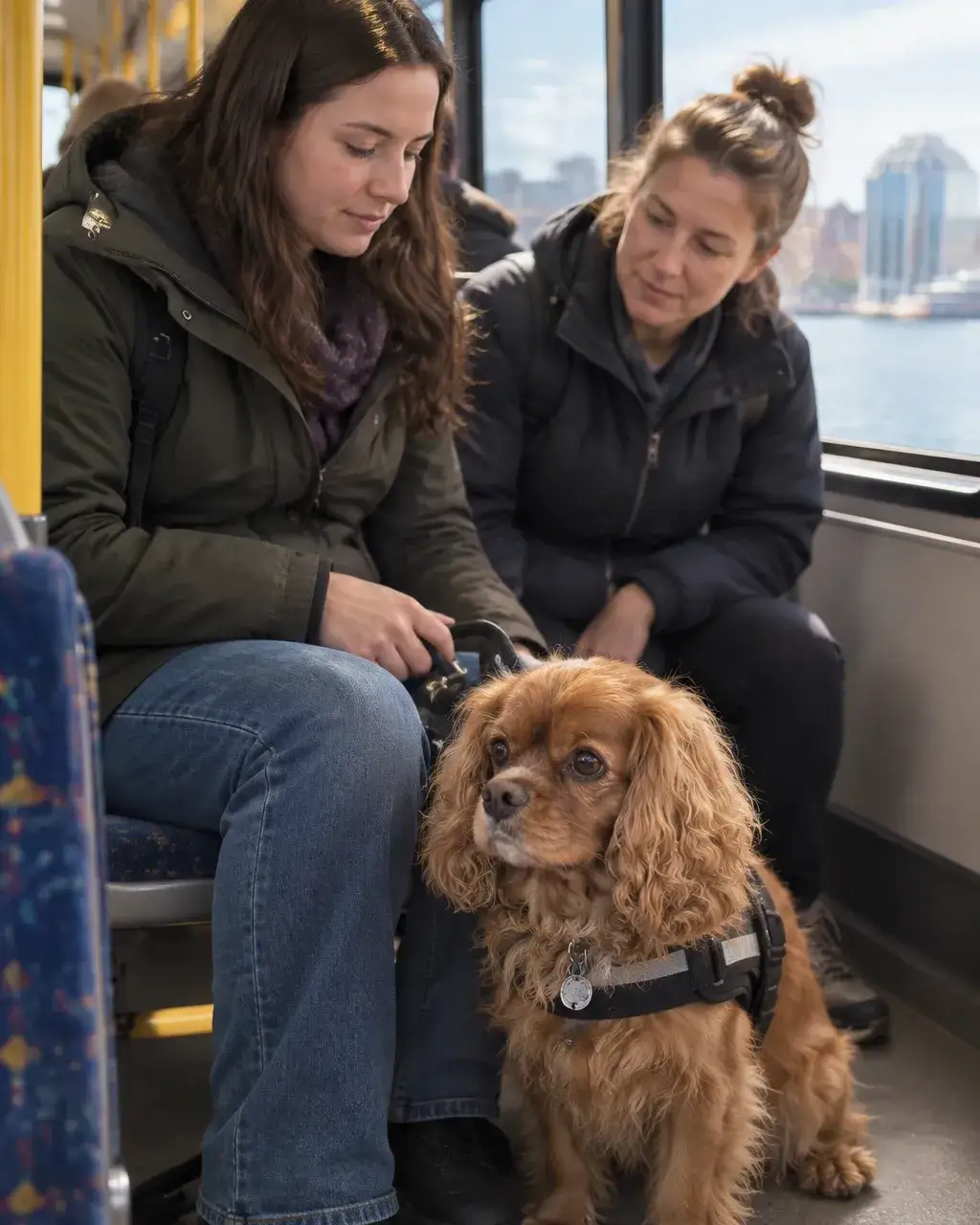
- Boarding and exiting public transit.
- Settling quietly in a restaurant.
- Remaining under control if the leash is dropped.
The current listed assessment cost is $187.50, payable to St. John Ambulance before the assessment. Check the current fee before making arrangements. If you receive income supports, ask the Service Dog Program whether the fee may be waived.
Renewal and identification
Nova Scotia certification is renewed every two years. Renewal requires reassessment of the team.
This reassessment applies across the board in Nova Scotia. It applies to teams certified through the accredited-school route and teams certified through the privately trained route.
Certified teams receive a provincial identification card naming the handler and dog. The dog must wear an identification collar or harness displaying “service dog” or the required prescribed wording while in public.
Handlers must:
- Maintain control of the dog at all times.
- Produce the identification card when properly asked.
- Ensure the dog wears the required identification.
- Prevent the dog from occupying a seat where food is served.
- Prevent the dog from occupying a seat on public transit.
- Attend reassessment at the two-year renewal point.
These requirements support safety, clarity, and respectful access for everyone.
Handler and trainer responsibilities
Certification works best when the handler and trainer understand their separate roles.
The handler is responsible for:
- Obtaining the medical, veterinary, and identification documents required for the provincial route.
- Submitting the application to the Nova Scotia Service Dog Program.
- Paying the assessment fee or asking about an income-support waiver.
- Practising with the dog in daily life so skills generalise beyond training sessions.
- Maintaining safe behaviour and control in public.
- Following identification and seating requirements.
- Attending reassessment at renewal.
The trainer is responsible for:
- Assessing whether the dog-handler partnership is suitable for service work.
- Identifying gaps early and adjusting the training plan.
- Teaching disability-mitigation tasks, calm public behaviour, reliable cues, and safe handling.
- Preparing the team for the 40-task public safety assessment.
- Monitoring stress, welfare, and readiness.
- Providing honest feedback without promising a pass.
- Explaining that training support is not provincial certification.
At Pawsitively Service Dogs, we focus on preparation, not promises. Our Nova Scotia and British Columbia service dog programs include structured coaching, public-access training, task development, and ongoing suitability evaluation.
Our Owner-Trainer Curriculum provides a staged approach to foundational skills, emotional regulation, public access, task reliability, generalisation, and assessment preparation.
CASDT is a standard, not Nova Scotia certification
The Canadian Association of Service Dog Trainers (CASDT) provides a voluntary professional industry standard. Its Recommended Training and Testing Procedures for Owner Trained Programs addresses owner-trainer program structure, public-access testing, and certification testing.
CASDT testing can include:
- A public access test.
- A certification test.
- Demonstration of disability-mitigation tasks.
- Evaluation of handler control, dog welfare, and public safety.
Passing CASDT testing does not replace Nova Scotia certification. A team that completes CASDT testing must still apply through the Nova Scotia Service Dog Program for provincial recognition.
Air travel is a separate federal question
Provincial certification and air travel are not the same legal process.
Under the Canadian Transportation Agency’s accessible transportation regulations, airlines must accept trained service dogs in the cabin, subject to the applicable requirements. For air travel, a service dog is defined as a dog individually trained by a person or organisation specialising in service dog training to perform a task related to a person’s disability.
An airline may ask for:
- A training declaration when you book.
- An identification card or training document before departure.
- Advance notice, commonly between 48 and 96 hours.
Requirements differ by carrier and situation. Review the CTA’s Service Dogs: A Guide and confirm the current process directly with your airline before travelling.
Pay-online registries do not certify a Nova Scotia team
There is no single national Canadian service dog registry. Some websites sell registration, identification cards, vests, and certificates without assessing the handler, dog, training, or public safety.
Those documents have no legal standing in Nova Scotia. They do not create access rights under the Service Dog Act. Presenting them as proof of provincial certification could raise concerns under the Act’s false-representation provisions.
Read our related guidance on fake service dog registries and why they do not certify your dog, and review our British Columbia service dog certification resources for information about route-specific provincial requirements.
Nova Scotia owner-trainer checklist
Use this checklist as a planning tool. It does not guarantee certification.
- Confirm suitability. Consider health, temperament, task needs, public behaviour, and the ability to work safely.
- Choose the correct route. Select accredited-school documentation or the privately trained route.
- Gather current documents. Obtain the application, medical form, veterinary form, photo, and any additional requirements.
- Build reliable skills. Practise calm public access and disability-mitigation tasks with qualified support.
- Apply and assess. Submit the application, confirm current fees or waiver options, and complete the St. John Ambulance assessment if required.
- Maintain the standard. If certified, use the provincial ID card and identification equipment, maintain control, and plan for two-year reassessment.
Certification is a provincial process. Good preparation is about safety, reliability, welfare, and an honest assessment of readiness.
You can seek professional guidance while keeping the application and certification decision with the Nova Scotia Service Dog Program. To learn more about our approach, read Melanie’s background and training philosophy. For questions about Nova Scotia services, email melanie@pawsitivelyservicedogs.ca. For British Columbia enquiries, email jenn@pawsitivelyservicedogs.ca. For general enquiries, email info@pawsitivelyservicedogs.ca or contact Pawsitively Service Dogs.