By Melanie Burneau, Owner & Head Trainer, Pawsitively Service Dogs Inc.
The province certifies. Trainers prepare.
In British Columbia, service dog certification has two separate parts.
The province decides whether a team meets the requirements for certification. A trainer helps the dog and handler develop the skills needed for safe, reliable work under the relevant route.
Pawsitively Service Dogs Inc. does not administer the British Columbia assessment, issue provincial certification, or guarantee that any dog will pass. Our role is to provide ethical, evidence-informed preparation and honest guidance throughout the training process.
British Columbia’s framework is established by the Guide Dog and Service Dog Act (SBC 2015, c. 17) and the Guide Dog and Service Dog Regulation. The program is administered by a Registrar in the Security Programs Division of the Ministry of Public Safety and Solicitor General through the provincial Guide Dog and Service Dog Program.
Certification in British Columbia is voluntary. You are not required to register your dog to train or work with them. However, certification under the Act provides specific legal protections and a recognised provincial route for eligible teams.
The two certification routes
Route one. Accredited-school team
A handler who receives a trained dog from a school accredited by Assistance Dogs International (ADI) or the International Guide Dog Federation (IGDF) follows the accredited-school route.
A valid identification card issued by an ADI- or IGDF-accredited training school is recognised under the Act, regardless of which province or country issued it. The team is considered certified and does not need to make a formal application for a provincial certificate to receive the Act’s protections.
The team may still choose to apply for a provincial certificate.
Examples of accredited schools in British Columbia include:
- Pacific Assistance Dogs Society
- BC & Alberta Guide Dog Services
- Vancouver Island Compassion Dogs
- CNIB Guide Dogs
Always confirm the current list and documentation requirements with the provincial program.
Route two. Self-trained or non-accredited team
This route applies when:
- You trained your own service dog.
- Your dog was trained by a school that is not accredited by ADI or IGDF.
You apply as a dog-handler team and must pass the British Columbia public safety assessment with your dog before certification can be issued.
Documents for the non-accredited route
For a new application, the provincial program requires documentation that includes:
- Medical Form Confirming Requirement for Guide Dog or Service Dog (SL403), completed by a Canadian or U.S. physician or nurse practitioner.
- Written confirmation from a Canadian or U.S. veterinarian, or an equivalent professional accepted by the Registrar, that the dog has been spayed or neutered.
- A photograph clearly showing your face.
- A copy of valid government-issued photo identification.
The dog must be spayed or neutered before a certificate can be issued.
Applications can be submitted through the province’s online system. If you are applying by mail, use SL402, the application for a guide or service dog certificate for a self-trained or non-accredited team.
Forms and processes can change. Before submitting anything, review the current provincial certification page and confirm that you are using the current form versions.
What the public safety assessment tests
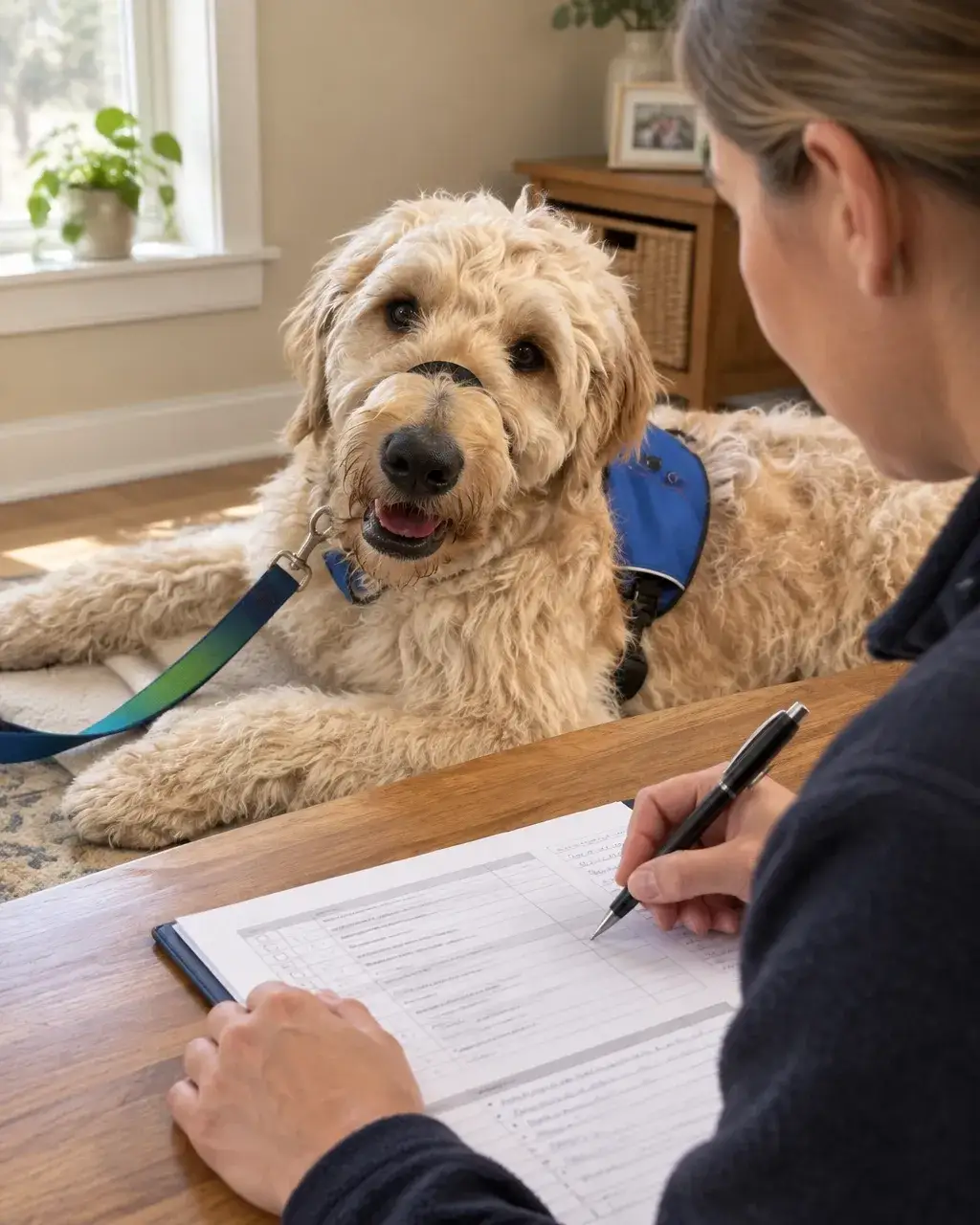
The British Columbia public safety assessment is currently administered by Obedience Unleashed Dog Training (OUDT).
The assessment was previously administered by the Justice Institute of British Columbia. Administration moved to OUDT on 1 April 2024, which explains why older online information may refer to the Justice Institute.
The assessment is performed while the dog is on-leash. It evaluates whether:
- The handler has control of the dog.
- The dog is safe in public.
- The dog remains calm, stable and reliable in commonly encountered situations.
- The team can work safely without major restraint.
- The dog demonstrates the required standard across all assessment tasks.
An occasional tight leash is acceptable. A dog is not ready if it requires major restraint or a continuously tight leash to complete a task, unless a tight leash is required because of the handler’s mobility limitations.
Only regular collars are accepted. Correction collars, including pinch collars, will not be accepted.
The team must pass all 40 tasks. You can review the official British Columbia Guide Dog and Service Dog Assessment form while preparing.
For an initial application, section 3(3) of the Regulation requires the assessment to be completed no more than 90 days after the Registrar receives the application.
Certification itself is free of charge. If an OUDT public safety assessment is required, the current assessment cost is $200. Confirm the current fee before booking.
Assessment locations currently include:
- Langley
- Coquitlam
- Kelowna
- Penticton
- Kamloops
- Prince George
- Nanaimo
- Victoria
Handler and trainer responsibilities
Certification is a shared process, but the responsibilities are not interchangeable.
The handler is responsible for:
- Choosing the appropriate certification route.
- Completing the current provincial application process.
- Obtaining the required medical, veterinary, photograph and identification documents.
- Maintaining control of the dog.
- Following the assessment’s on-leash and collar requirements.
- Keeping the dog safe, calm and reliable in public.
- Responding to renewal requirements or written notices from the Registrar.
The trainer is responsible for:
- Helping the team develop disability-mitigation tasks.
- Building reliable public-access skills.
- Supporting calmness, neutrality and safe handling.
- Preparing the team for the 40-task assessment through realistic practice.
- Monitoring progress and welfare.
- Explaining the limits of training support.
At Pawsitively, we do not rehearse a guaranteed result. We build skills gradually, generalise them across realistic environments and assess whether service work remains appropriate for the individual dog.
Our service dog programs and owner-trainer curriculum are designed to support that process. Acceptance into training does not guarantee certification or service dog status.
Renewal and reassessment. The route matters.
British Columbia certification renews on a two-year cycle. Renewal requirements depend on how the team was trained.
Under section 4 of the Regulation:
- Accredited- or recognised-school teams renew with an unofficial photograph of the handler and a copy of the handler’s identification card. No assessment is required at renewal for this route.
- Self-trained teams and teams from non-accredited schools must complete a British Columbia guide dog and service dog assessment no more than 90 days after the Registrar receives the renewal application. The application also requires an unofficial photograph and written confirmation from an approved assessment organisation, currently OUDT.
There is an additional safeguard. Under section 8(2), the Registrar may require reassessment at any time by written notice. This applies regardless of which route the team followed.
In short, British Columbia does not require assessment at every renewal for every team. However, reassessment at renewal applies to self-trained and non-accredited-school teams, while accredited-school teams renew on documents. The Registrar may also require reassessment at any time.
Rights of certified teams
Under the Act, certified dog-handler teams have the same rights as people who are not accompanied by dogs. Provided the dog is well behaved, a certified team cannot be denied access to:
- Restaurants and cafés
- Buses and taxis
- Hotels, motels and bed and breakfasts
- Other businesses
- Public places
Strata bylaws and rental terms that prohibit or restrict pets do not apply to certified guide and service dogs.
Certification remains voluntary. A person with a disability who relies on an uncertified dog, or a dog certified through another authority, still has equal rights to access public services and places and rental or strata housing under the British Columbia Human Rights Code. The specific access and tenancy protections under the Guide Dog and Service Dog Act attach to certified teams.
Visitors to British Columbia must apply for certification if they want to receive the Act’s specific protections while in the province.
Related rules and boundaries
Therapy animals and emotional support animals, including dogs, are not eligible for certification under the Act.
It is an offence to falsely represent a dog as belonging to a guide or service dog team. Interfering with or harming a guide or service dog is also an offence under the Prevention of Cruelty to Animals Act.
The former dog-in-training certification under the Guide Dog and Service Dog Act has been cancelled. Employees and volunteers training dogs for ADI- or IGDF-accredited schools no longer apply for dog-in-training certification. They apply for dog trainer certification through the accredited school.
Paid online “registry” documents do not replace BC certification
A paid online registry, certificate, identification card or vest does not replace the British Columbia application or assessment process.
These commercial documents have no legal standing under the Act. They do not establish that a dog has passed the provincial public safety assessment, and they do not create provincial certification.
The important question is not whether a card or vest looks official. The question is whether the team meets the applicable legal route and certification requirements. Misrepresenting a dog as belonging to a guide or service dog team is an offence.
For more detail, read Fake Service Dog Registries: What They Are and Why They Don’t Certify Your Dog.
A calm BC owner-trainer checklist
Use this as an organising tool, not a guarantee of certification.
- Confirm suitability. Identify the disability-related tasks and public-access skills that need to become reliable. Consider the dog’s temperament, health, resilience and welfare.
- Confirm the route. An accredited-school team may rely on valid ADI/IGDF school identification. A self-trained or non-accredited team must apply and complete the BC assessment.
- Gather current documents. Obtain SL403, veterinary confirmation of spay or neuter, a clear handler photograph and government-issued photo identification.
- Train for safe reliability. Practise calm public behaviour, on-leash control and all 40 assessment tasks. Use a regular collar, not a pinch or other correction collar.
- Submit and schedule. Apply through the provincial online system or use SL402 by mail. If required, arrange the OUDT assessment within the 90-day window after the Registrar receives the application.
- Track renewal requirements. Accredited- or recognised-school teams renew with documents. Self-trained and non-accredited-school teams need the qualifying BC assessment. Remember that the Registrar may require reassessment at any time under section 8(2).
Preparing in Victoria and the West Shore
Pawsitively supports handlers across Greater Victoria and the West Shore, including Victoria, Langford, Colwood and Saanich. Our Victoria, BC service dog training page explains the local support available.
You can also learn more about Jenn's background and approach, explore our service dog programs, or contact Pawsitively.
For British Columbia enquiries, email jenn@pawsitivelyservicedogs.ca.
For Nova Scotia enquiries, email melanie@pawsitivelyservicedogs.ca.
For general enquiries, email info@pawsitivelyservicedogs.ca.
If you are comparing provincial frameworks, you can also read our How Service Dog Certification Works in Nova Scotia article for related service dog guidance. The rules in this article apply to British Columbia specifically.
The goal is an honest, reliable partnership
A trainer can help you prepare thoughtfully. The province decides certification through its own framework.
The goal is not simply to obtain a card. It is to build a safe, stable partnership that is honestly ready for the relevant assessment or document route. Progress should be measured carefully, welfare should remain central and every decision should support the long-term wellbeing of both handler and dog.
Sources
- BC Guide Dog and Service Dog Certification overview
- BC Guide Dog and Service Dog Team Certification
- BC Certification Testing
- The Rights of Certified Dog and Handler Teams
- Guide Dog and Service Dog Act, SBC 2015, c. 17
- Guide Dog and Service Dog Regulation, B.C. Reg. 223/2015, consolidated to 29 September 2026
- Official BC Guide Dog and Service Dog Assessment form
- BC Guide Dog and Service Dog forms
- BC Guide and Service Dogs contact information