Public access training is often misunderstood.
Some people imagine a service dog that heels perfectly through a shop, never looks away from the handler, and responds like a machine. That is not the complete picture. A working service dog must do more than walk neatly beside you.
The dog must remain safe, composed, responsive, and unobtrusive in changing environments. The handler must be able to guide the dog, recognize stress, manage unexpected situations, and make responsible decisions about whether the dog is ready to continue.
Public access is about building a reliable partnership. It is not about demanding robotic perfection.
Public Access Is About More Than Obedience
Basic obedience is the entry ticket, not the destination.
A service dog needs foundational skills such as:
- Responding to cues promptly.
- Walking safely on leash.
- Staying near the handler.
- Sitting, lying down, and waiting.
- Coming when called where appropriate.
- Ignoring food, people, animals, and other distractions.
- Toileting reliably in suitable locations.
- Remaining under the handler’s control.
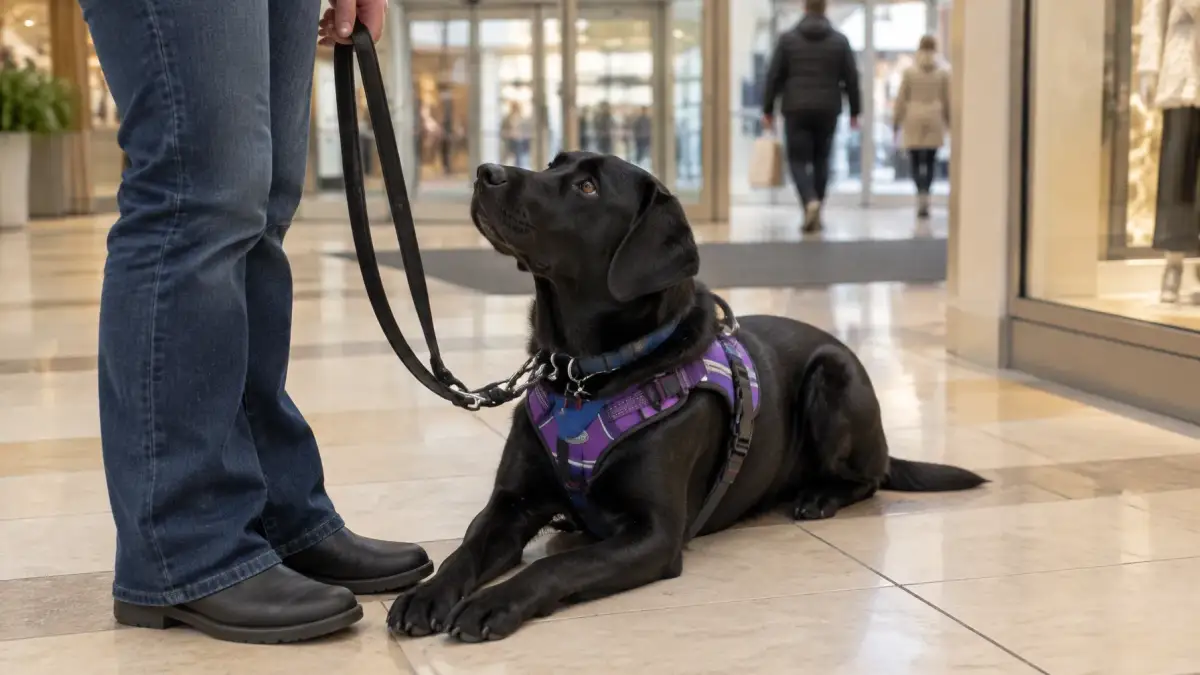
These behaviours create the foundation for public access. However, a dog that can sit in a quiet training room is not automatically ready for a crowded mall, a medical appointment, or public transportation.
Public access training develops the dog’s ability to use those skills in many different settings while remaining emotionally stable.
Entering and Moving Through Buildings
A working team needs a calm, practical routine for entering and exiting buildings.
This includes:
- Waiting at entrances without pulling or rushing.
- Passing through automatic doors.
- Navigating narrow entryways.
- Riding elevators calmly.
- Walking up and down stairs safely.
- Moving across different floor surfaces.
- Pausing when a doorway or path is blocked.
- Maintaining a position that does not obstruct others.
Automatic doors can open suddenly. Elevators can be crowded and noisy. Stairs may be slippery, open-backed, steep, or unfamiliar. Floors may change from tile to carpet, polished concrete, rubber, or metal grating.
The dog does not need to treat every new surface as insignificant immediately. The goal is to introduce these experiences gradually and help the dog develop confidence. If the dog shows uncertainty, we reduce the difficulty, create space, and support a successful response.
Crowds, Aisles, and Shopping Carts
Public spaces rarely remain predictable.
A dog may need to work around:
- Crowded aisles.
- People moving quickly from different directions.
- Shopping carts and mobility devices.
- Children walking, running, or reaching.
- People stopping suddenly.
- Bags, umbrellas, parcels, and dropped items.
- Narrow spaces where passing is difficult.
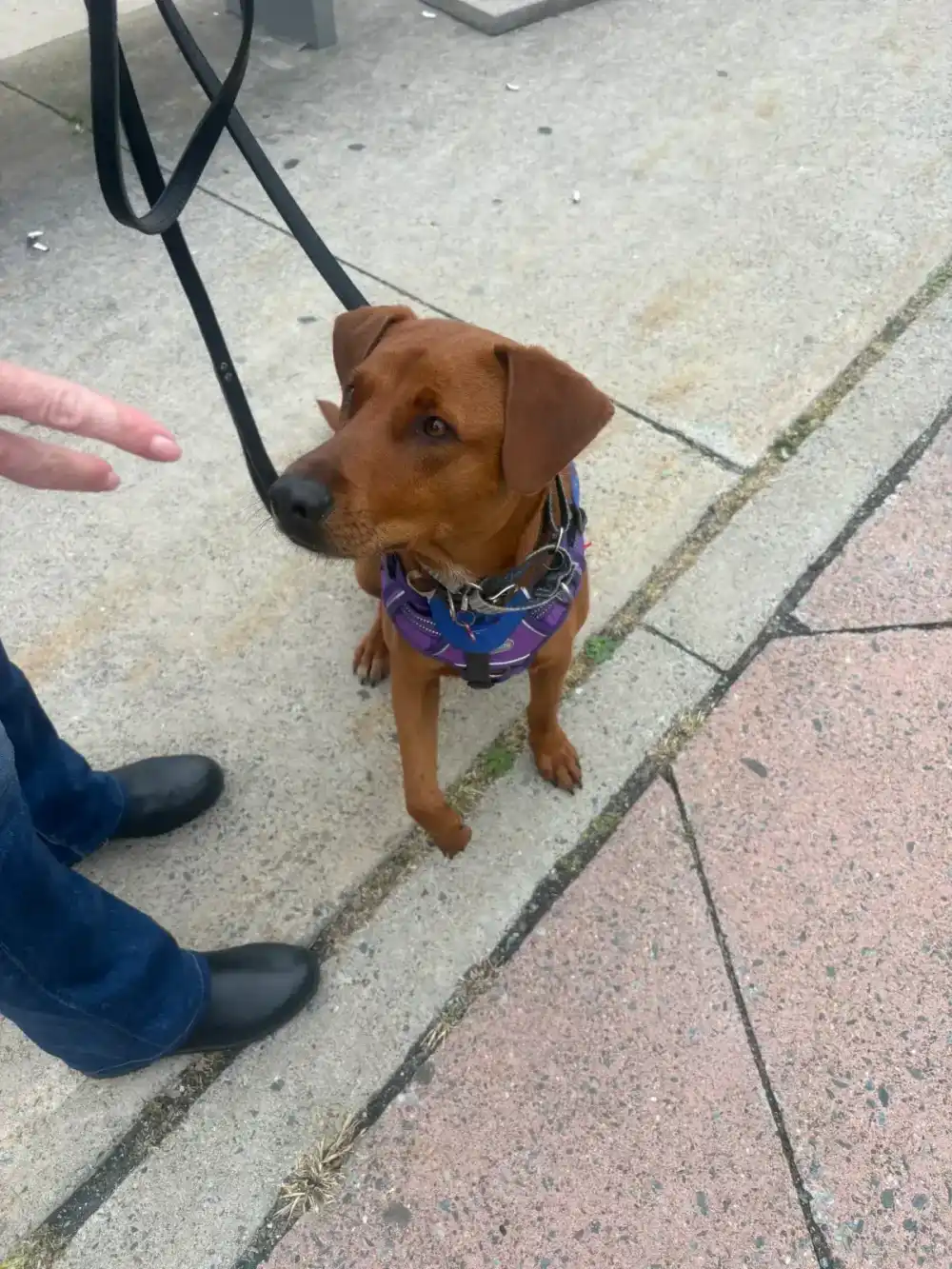
The dog must learn to stay close without weaving into people, forging ahead, or becoming startled by objects passing nearby. The handler must also choose an appropriate route and protect the dog’s working space.
Public access is not a test of how tightly a dog can heel for an entire shopping trip. It is a test of whether the team can move safely and thoughtfully through the environment.
Sometimes the best response is to pause. Sometimes it is to move to the side. Sometimes it is to leave the area and try again later.
Food, Restaurants, and Settling
Food is one of the most important public access distractions.
A service dog may encounter food:
- On the floor.
- In a person’s hand.
- On a low table.
- On a restaurant chair or bench.
- In a shopping cart.
- Near a food court.
- Beside the handler’s feet.
The dog needs to leave food alone unless a task specifically requires interaction with an item. Scavenging is unsafe and disruptive, even if the dog is otherwise friendly.
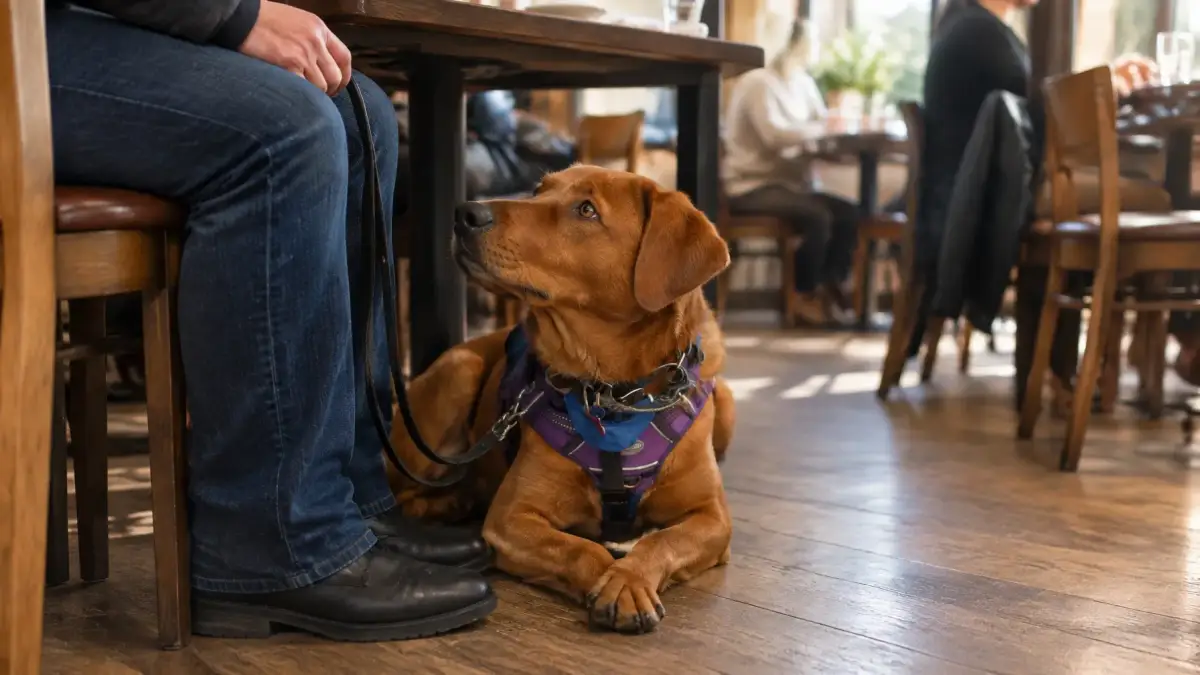
In a restaurant, the dog should settle under or beside the table without blocking the aisle, other customers, or staff. The dog should remain quiet and should not solicit attention from diners.
Settling is an active skill. It requires the dog to rest while people walk past, dishes move, chairs scrape, and food is carried nearby. We build this skill in stages rather than expecting a young or inexperienced dog to settle for a long meal immediately.
Medical Environments
Medical environments can be especially challenging.
A dog may encounter:
- Wheelchairs and walkers.
- Medical equipment.
- Strong smells.
- Alarms and intercoms.
- People who are unwell or distressed.
- Tight waiting rooms.
- Long periods of quiet waiting.
- Sudden movement or unusual sounds.
The dog needs to remain responsive without interfering with care. This includes staying in an appropriate position, avoiding contact with equipment, and remaining under the handler’s control.
Not every area of every medical facility will be suitable for a dog. Infection-control, treatment, or safety requirements may restrict access to particular spaces. A trained team must be able to work within those boundaries and respond calmly when the dog cannot accompany the handler into a specific area.
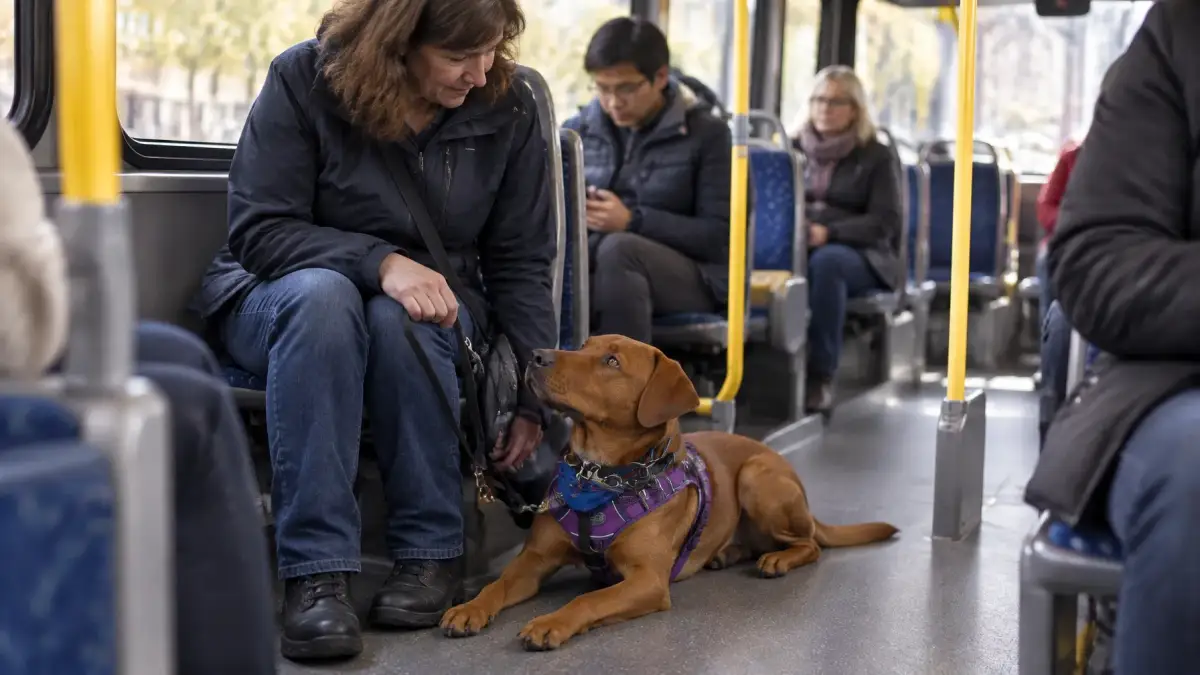
Public Transportation
Public transportation adds movement, noise, confined spaces, and changing surfaces.
Training may include:
- Waiting at a stop without pulling toward people or vehicles.
- Boarding calmly.
- Staying close while passengers move around.
- Settling at the handler’s feet.
- Avoiding seats and aisles.
- Remaining composed when the vehicle starts, stops, or turns.
- Exiting safely without rushing.
The dog may need to work on buses, trains, ferries, or other forms of transportation depending on the handler’s needs and location.
The handler also needs a plan. This may include choosing quieter travel times at first, identifying where the dog can settle safely, and knowing when the environment has become too difficult for the current stage of training.
Other Dogs, Children, and Unexpected Events
Public access requires neutrality around other living beings.
The dog may encounter:
- Calm dogs passing at a distance.
- Dogs staring, barking, pulling, or lunging.
- Dogs that approach rudely.
- Children who reach, run, shout, or move unpredictably.
- People who attempt to pet or distract the dog.
- Unexpected noises such as dropped objects, alarms, or construction.
- Sudden changes in the environment.
Neutrality does not mean the dog never notices anything. It means the dog can notice a distraction and return attention to the handler without becoming unsafe or disruptive.
A rude dog may require the handler to create distance. A child may need to be redirected before reaching the service dog. People who want more guidance on service dog etiquette should understand that approaching, petting, or distracting a working dog can interfere with the team. A sudden noise may cause the dog to startle.
Startling is not automatically a training failure. What matters is what happens next.
The dog should be able to recover, reconnect with the handler, and continue when it is genuinely ready. If recovery does not occur, the handler must increase distance, end the outing, or provide another appropriate form of support.
What Makes Public Access Inappropriate?
Public access becomes inappropriate when the dog cannot remain safely under the handler’s control.
Examples may include:
- Uncontrolled barking.
- Lunging at people, dogs, or objects.
- Aggressive behaviour.
- Repeatedly soliciting attention.
- Scavenging food.
- Persistent pulling or dragging the handler.
- Repeated attempts to escape.
- Inability to settle or remain in position.
- Behaviour that blocks paths, aisles, or doorways.
- General inability to respond to the handler.
This does not mean that one good-natured mistake automatically disqualifies a dog. Dogs are living animals, and occasional errors can happen during learning. The concern is a repeated pattern, a lack of handler control, or behaviour that creates a safety or access problem.
The handler must assess the whole picture. Is the dog responding to support? Is the behaviour improving? Can the team safely continue? These decisions should be based on observation rather than pride or pressure.
Welfare Is a Core Public Access Standard
A dog that technically obeys but is chronically stressed in public is not an appropriate working service dog.
Compliance is not the same as comfort.
A dog may remain still while showing signs of fear, shutdown, avoidance, or sustained tension. A dog may follow cues while struggling to cope with the environment. Those signs matter.
Responsible public access training monitors:
- Body language.
- Recovery time.
- Appetite and willingness to take reinforcement.
- Ability to rest.
- Changes in movement or engagement.
- Avoidance or freezing.
- Repeated stress behaviours.
- Whether the dog can work without becoming overwhelmed.
The dog’s welfare is not separate from reliability. A chronically stressed dog is less able to respond, learn, recover, and perform tasks safely.
Our goal is not to force a dog through increasingly difficult environments. Our goal is to develop confidence, resilience, neutrality, and functional skills while respecting the dog’s limits.
Progression Must Be Gradual
Public access skills generalize slowly.
A behaviour that is reliable in a quiet training room may not yet be reliable in a busy mall. A dog that settles for ten minutes may not be ready for a long appointment. A dog that ignores one calm dog may need more support around a barking dog.
Progression should depend on:
- Emotional stability at the current level.
- Safe handler control.
- Consistent responses.
- Appropriate recovery.
- The dog’s ability to rest and re-engage.
- The absence of repeated stress signals.
We may begin with a quiet entrance, then introduce automatic doors. We may practise a short elevator ride before adding crowds. We may train restaurant settling outside during a quiet period before attempting a full meal.
Increase one challenge at a time whenever possible. Rushing public access creates problems rather than preventing them.
For a broader discussion of training timelines, read How Long Does It Take to Train a Service Dog?. You can also review our owner-trainer curriculum to understand how structured progression supports long-term development.
Public Access and the Canadian Context
Public access rules differ across Canada. Provincial and territorial requirements, human-rights protections, municipal rules, and federal transportation regulations may all be relevant depending on the setting.
In British Columbia, Alberta, and Nova Scotia, service dog certification is voluntary. Handlers are not required to register their dogs simply to train or work with them. However, certification, assessment, documentation, and access rights are not identical in every province or setting.
The province certifies teams; trainers prepare them.
A trainer can support your dog’s skills, handler knowledge, and preparation. We cannot certify a team or guarantee service dog status. You are responsible for reviewing the requirements that apply to your province and the places where you need to work.
Public access training should also remain connected to the dog’s purpose. For task development, see What Tasks Can a Service Dog Be Trained to Do?. If you are still considering whether your dog is a suitable candidate, Is My Dog Suitable to Be a Service Dog? may help you identify the questions that require careful assessment.
Building a Safe Working Partnership
A capable service dog is not defined by perfect performance in every moment.
A capable team can:
- Enter and exit calmly.
- Navigate changing environments.
- Maintain a safe position.
- Ignore ordinary distractions.
- Respond to the handler.
- Recover from unexpected events.
- Recognize when a break is needed.
- Leave an environment when welfare or safety requires it.
Public access is a gradual process of practice, observation, and adjustment. It combines obedience with environmental confidence, neutrality, handler control, recovery, and welfare.
If you are considering owner-training, our service dog programs provide structured support for building these skills. You can also contact us to discuss your dog, your goals, and the environments you need to navigate.
Melanie Burneau
Owner & Head Trainer
Pawsitively Service Dogs Inc.
Nova Scotia: melanie@pawsitivelyservicedogs.ca
British Columbia: jenn@pawsitivelyservicedogs.ca
General inquiries: info@pawsitivelyservicedogs.ca